English
 Français
 عربى
عربى
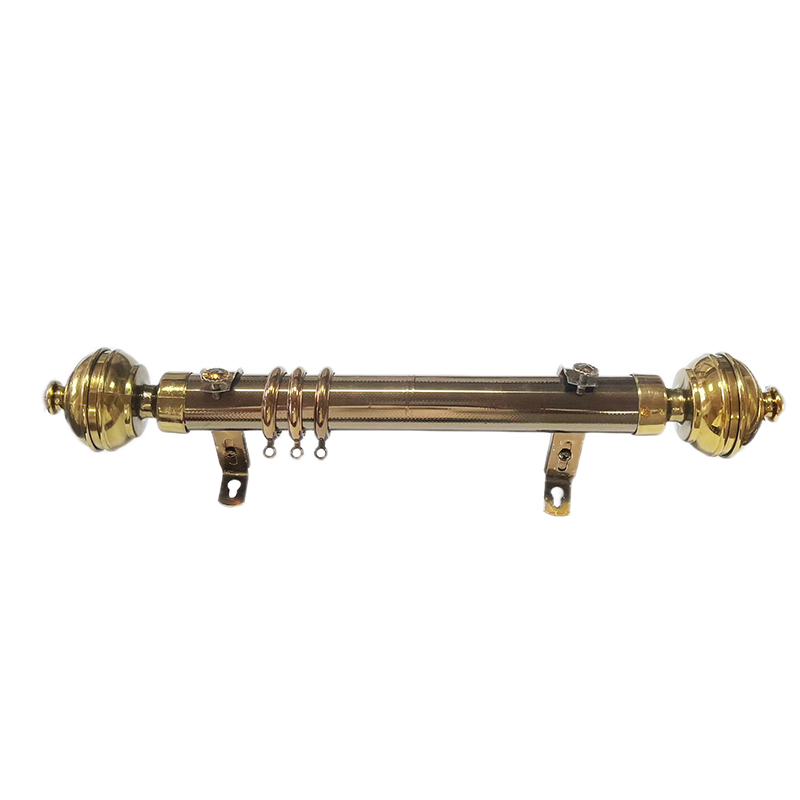
To install a curtain rod, mark bracket positions 10 to 20 cm above the window frame and 15 to 30 cm beyond each side, drill wall anchors into the correct wall type, screw the brackets firmly, thread curtains onto the rod, seat the rod in the brackets, and fit finials. The whole process takes 30 to 60 minutes for a standard single window. A double curtain rod bracket mounts two rods at different projections from the wall, allowing a sheer or voile panel on the inner rod and a blackout or lined drape on the outer, giving full light and privacy control from one bracket set. The three main Curtain Rod materials are PVC Curtain Rod (lightest, moisture-proof, best for wet rooms), Aluminum Curtain Rod (versatile, corrosion-resistant, the everyday standard), and Iron Curtain Rod (heaviest, most architectural, for large-scale and period interiors). This guide delivers the full practical detail for every keyword from basic installation to complex double-rod systems.
Where to Hang Curtain Rods: Positioning Rules That Make Every Window Look Its Best
Understanding where to hang curtain rods is the first decision before any drilling starts, and it is the decision that has the greatest visual impact on how the room feels. The same curtains hung at the wrong height look mediocre; hung at the right height they transform the proportions of the entire wall.
Height Above the Window: The Rule That Changes Room Proportions
The standard recommendation from interior designers and window treatment professionals is to mount the curtain rod 10 to 20 cm (4 to 8 inches) above the window frame for standard ceiling heights of 2.4 to 2.7 m. The higher within this range you mount the rod, the taller the window appears. For ceiling heights above 2.7 m (9 feet), mount the rod 15 cm (6 inches) below the ceiling line rather than above the window. Hanging the rod this high and allowing floor-length curtains to fall straight down creates a dramatic sense of height regardless of how small the actual window is.
A practical example: a window 120 cm wide and 100 cm tall mounted in a 2.5 m ceiling room, with the rod placed 18 cm above the frame and 20 cm beyond each side, will appear to be approximately 160 cm wide and 140 cm tall once floor-length curtains are hung. This is the core principle behind using window curtain rods to make modest windows feel generous.
Width Beyond the Window: Maximizing Light When Curtains Are Open
The rod should extend 15 to 30 cm (6 to 12 inches) beyond the window frame on each side. This extension allows the curtain fabric to stack completely off the glass when the curtains are open, so the full window area is unobstructed and maximum daylight enters the room. A rod that only extends 5 to 8 cm beyond the frame forces the curtain to overlap the glass when open, reducing light by 20 to 40% even with the curtains technically in their open position.
For very wide windows above 200 cm, extending 25 to 35 cm per side ensures the curtain stack sits entirely off the glass. The additional rod extension also has the visual effect of making the window appear significantly wider, which is a desirable outcome in most residential and commercial settings.
Curtain Length: Floor-Length vs. Sill-Length vs. Apron-Length
Where you hang the rod also determines which curtain length looks correct for the window. The three standard curtain lengths each create a different effect:
- Floor-length (to within 1 to 2 cm of the floor): The most elegant and design-forward option, recommended for living rooms, bedrooms, and any formal space. Requires knowing the exact floor-to-rod measurement before ordering curtains.
- Apron-length (15 to 20 cm below the window sill): Used when furniture sits directly below the window and floor-length curtains would not hang freely, such as below kitchen sinks or behind radiators.
- Sill-length (to the window sill): Practical for bathroom and kitchen windows where floor-length curtains would collect moisture or cleaning chemicals. Gives a neat, functional appearance without pretension to drama.
| Ceiling Height | Rod Height Above Frame | Side Extension Per Side | Recommended Curtain Length |
|---|---|---|---|
| Under 2.4 m | 10 to 12 cm | 15 to 20 cm | Floor-length or apron |
| 2.4 to 2.7 m | 15 to 20 cm | 20 to 25 cm | Floor-length |
| 2.7 to 3.0 m | 15 cm below ceiling | 25 to 30 cm | Floor-length (with slight puddle optional) |
| Above 3.0 m | Near ceiling line | 30 to 35 cm | Floor-length with deliberate puddle |
How to Install a Curtain Rod: Full Step-by-Step for Every Wall Type
Knowing how to install a curtain rod correctly from the beginning avoids the two most common failures seen in residential installations: brackets that pull out of the wall under the weight of the curtains, and rods that hang visibly off-level. Both failures are entirely preventable with the right preparation and the right fixings for the wall type.
Tools and Materials Checklist
- Electric drill with bits matched to the wall type: masonry bit (5 to 8 mm) for brick and concrete, HSS bit for timber, tile bit for ceramic or porcelain
- Spirit level at least 60 cm long for reliable accuracy across the full bracket span
- Tape measure and pencil for marking bracket positions
- Screwdriver (typically Phillips No. 2) for driving bracket screws
- Wall anchors appropriate to the wall type: plastic rawlplugs for masonry, heavy-duty hollow wall anchors (Toggler or Fischer equivalent) for plasterboard
- Stud finder for plasterboard walls to locate timber studs for the strongest possible fixing point
- Pencil or chalk for marking drill positions
Step 1: Mark the First Bracket Position
Decide on the height above the window frame (typically 15 to 20 cm for standard ceiling heights). Measure up from the top of the window frame to that height on one side and make a pencil mark. Hold the bracket at this mark and use a pencil to mark through each screw hole in the bracket onto the wall. This gives you the individual screw positions for the first bracket without guessing.
Step 2: Mark the Second Bracket Position at Exactly the Same Height
Measure across to the second bracket position. Hold the spirit level between the first bracket mark and the second bracket position and adjust the height of the second mark until the bubble is perfectly centered. Only then mark the second bracket's screw holes. This two-mark-plus-level technique is faster and more accurate than measuring up from the floor on both sides (floor-to-ceiling heights often vary by 5 to 15 mm across a room, making floor measurement unreliable for level installation).
Step 3: Drill and Anchor
Drill each marked screw position to the correct depth. For standard 6 mm plastic rawlplugs in masonry, drill 35 to 45 mm deep with a 6 mm masonry bit. Blow or vacuum the dust from each hole before inserting the anchor. Push the anchor flush with the wall surface. For plasterboard walls where no stud is present, use a hollow wall anchor capable of spreading behind the board to grip: lightweight toggle anchors hold 15 to 25 kg in 12.5 mm plasterboard, which is sufficient for most window curtain rod installations.
Step 4: Mount the Brackets
Align each bracket with its anchors and drive the screws by hand first to catch the thread in the anchor, then tighten firmly with the screwdriver. Apply firm downward and outward pressure to the bracket by hand after all screws are tight to verify it does not shift or wobble. A bracket that moves under hand pressure will fail when curtains are loaded. Re-drill with the next size up anchor if any bracket remains loose.
Step 5: Thread Curtains and Mount the Rod
Thread the curtains onto the rod before mounting it in the brackets wherever possible. For eyelet curtains, weave the rod through the alternating rings. For tab-top or rod-pocket curtains, slide the fabric onto the rod from one end. For curtain rings with clips or hooks, hang the curtain rings onto the rod and attach the curtain to the rings before mounting. Once curtains are on the rod, lift the rod into the bracket cups and secure the retaining screw or snap-lock mechanism on each bracket. Press the rod firmly downward to confirm seating, then fit the finials on each end.
Step 6: Check Level and Adjust
Once the curtains are hung, stand back and view the installation from across the room. Small level errors that were invisible on the wall become very apparent when you can see the line of the curtain hem. If the rod appears off-level, most bracket cup designs allow the rod to be slightly repositioned without re-drilling by loosening the retaining screw, adjusting the rod angle, and re-tightening. For off-level mounting that exceeds the bracket's adjustment range, the lower bracket must be raised slightly by plugging the old holes with filler, allowing to dry, re-marking, and re-drilling.
Wall Type Considerations: Matching Fixings to the Structure
| Wall Type | Drill Bit Required | Recommended Anchor | Notes |
|---|---|---|---|
| Solid brick or concrete | 6 to 8 mm masonry | Plastic rawlplug (6 to 8 mm) | Strongest fixing; use hammer drill |
| Plasterboard over stud | 3 to 4 mm HSS | Screw directly into stud | Locate stud with finder first |
| Plasterboard (no stud) | 6 mm standard | Hollow wall anchor (toggle) | Never use standard rawlplugs |
| Timber (frame or panel) | 3 mm HSS pilot | No anchor needed; screw direct | Drill pilot to prevent splitting |
| Ceramic or porcelain tiles | 6 mm tile/diamond bit | Rubber-gasketed rawlplug | No hammer action; low speed |
Window Curtain Rods: Types, Sizes, and Standard Specifications
Window curtain rods are available in a range of diameters, lengths, and materials, and understanding the specifications prevents both under-buying (a rod that bows under curtain weight) and over-buying (spending on a heavy iron rod for a voile panel that only needs a lightweight aluminum option).
Standard Curtain Rod Diameters and Their Load Capacity
The rod diameter is the primary structural variable. A larger diameter rod has dramatically greater stiffness (bending stiffness scales with the fourth power of the radius, meaning a 35 mm rod is over twice as stiff as a 28 mm rod of the same material and wall thickness). Standard residential rod diameters and their typical curtain weight capacity with brackets at 90 cm spacing:
- 16 mm diameter: For sheer and lightweight voile panels up to approximately 3 kg total load. Used in café curtain and half-window applications. Maximum unsupported span: 90 cm.
- 19 to 22 mm diameter: For lightweight to medium curtains up to approximately 6 kg total load. Suitable for single standard-weight curtain panels in a bedroom or small living room. Maximum unsupported span: 120 cm.
- 25 to 28 mm diameter: The most widely used size range for residential window curtain rods. Supports medium to heavy curtains up to 15 to 20 kg total load. Maximum unsupported span: 180 cm. Use a center bracket for spans above 180 cm.
- 35 mm diameter: For heavy lined or interlined curtains up to 30 kg total load. Required for very wide windows (above 250 cm) where multiple fabric panels create significant combined weight. Maximum unsupported span: 220 to 250 cm.
- 50 mm diameter: Premium architectural specification, typically in iron or heavy aluminum. For very heavy drapes in large-scale rooms, bay windows with multiple panels, or commercial applications. Supports loads above 40 kg.
Extendable Curtain Rods vs. Fixed-Length Rods
Extendable (telescoping) curtain rods have an inner section that slides to length and locks in position with a friction collar or tension screw, allowing one rod to cover a range of window widths. The typical range of a residential extendable rod is from 70 cm to 130 cm, or from 120 cm to 220 cm for wider versions. The advantage is convenience: one rod fits a range of windows. The limitation is that the overlap joint between the inner and outer tubes is a potential weak point under heavy loads, and the rod is less rigid at full extension than at minimum length. For window widths that fall in the mid-range of an extendable rod's span, a fixed-length cut-to-size rod from aluminum or steel will always be stiffer and stronger.
Curtain Rod Fitting: Bracket Types and Their Applications
The curtain rod fitting (bracket) is the component that transfers the curtain and rod weight into the wall. Bracket design determines projection distance from the wall, maximum load, and aesthetic. Main bracket types:
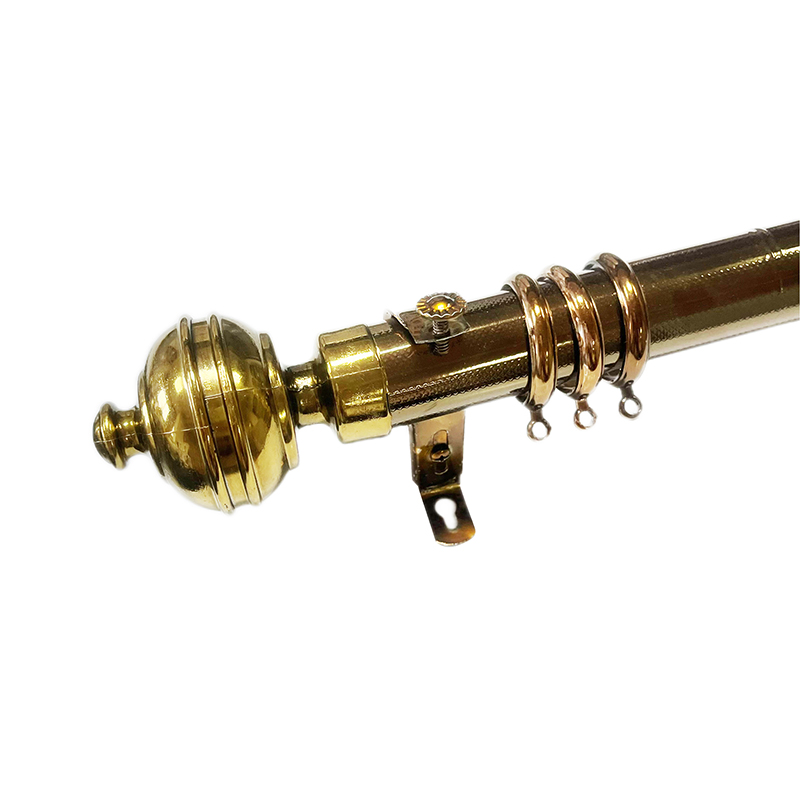
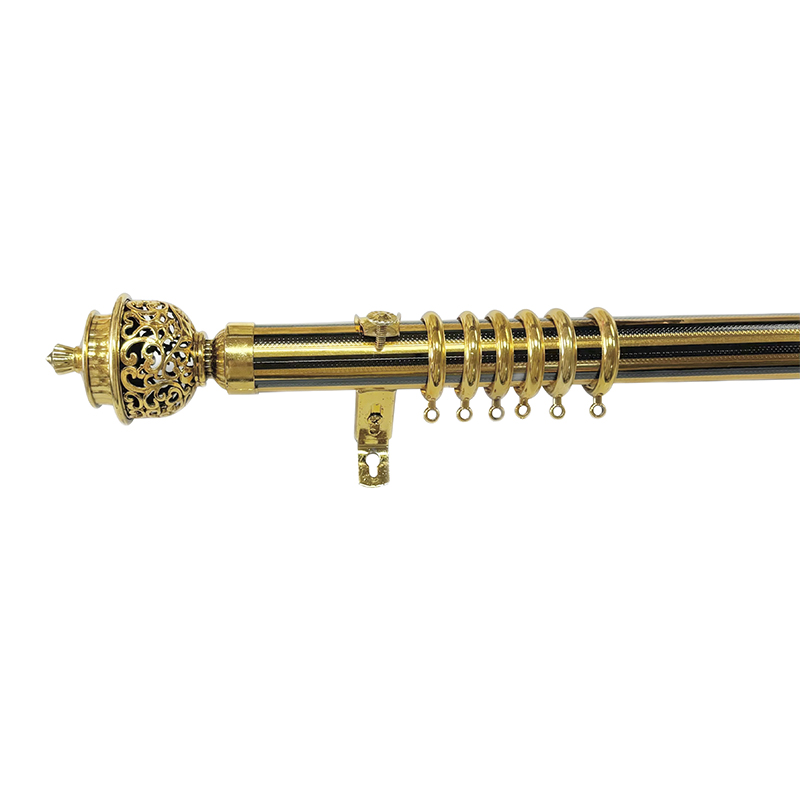
- Standard cup bracket: An open-top cup that the rod sits in and is retained by a small screw. Projection from the wall of 5 to 10 cm. Suitable for single-rod lightweight to medium installations. Most common bracket type for residential window curtain rods.
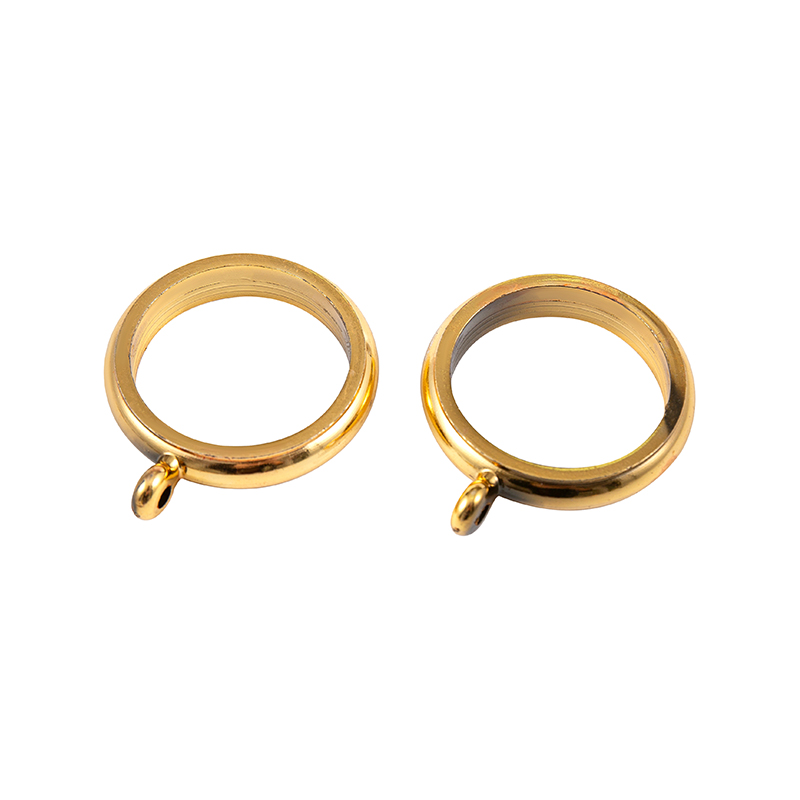
- Enclosed ring bracket: A full ring that the rod threads through during installation rather than sitting in from above. More secure than a cup bracket as the rod cannot lift out under any load. Required for heavier iron curtain rods where cup brackets may not reliably retain the rod under vibration or load cycling.
- Adjustable projection bracket: Allows the bracket arm length to be set at different positions, changing how far the rod sits from the wall. Useful for bookshelves or furniture adjacent to windows where the standard bracket projection would place the rod too close to the furniture face.
- Ceiling-mount bracket: Fixed to the ceiling rather than the wall, allowing the rod to be suspended from above. Used when wall space above the window is insufficient for a standard wall-mount bracket, or in bay window configurations where a ceiling-run track gives a cleaner look.
Curtain Rod Double and Double Curtain Rod Bracket: Full System Guide
A curtain rod double system (also called a double curtain rod) uses two parallel rods at different distances from the wall, held by a double curtain rod bracket that projects two cup or ring positions from the same wall fixing. This setup is the standard solution for combining decorative and functional curtain layers at the same window without cluttering the wall with multiple separate bracket sets.
Why Double Curtain Rod Systems Are Used
The double rod system is used when a window requires two independently operable curtain layers serving different functions:
- Sheer plus blackout: The inner (back) rod carries a voile or sheer panel that softens daylight and provides privacy during daytime without blocking light. The outer (front) rod carries a blackout or thermal-lined panel closed at night for complete light exclusion and insulation. This is the most common double rod application in bedrooms.
- Decorative plus functional: The inner rod carries a lighter decorative sheer while the outer rod carries a heavier statement drape. This layered look is a standard feature in well-decorated living rooms and dining rooms where the curtains are a central design element.
- Privacy plus insulation: In very cold climates, two layers of lined curtains provide significantly better thermal insulation than one layer, reducing heat loss through the window by up to 35% compared to a single lined curtain panel. The double rod makes operating both layers independently convenient.
How a Double Curtain Rod Bracket Works
A double curtain rod bracket consists of a single wall-mount plate with two bracket arms of different lengths projecting from it, each terminating in a rod cup or ring. The inner arm (shorter, closer to the wall) typically projects 5 to 7 cm from the wall, and the outer arm (longer, farther from the wall) projects 10 to 14 cm. The two rods are mounted parallel to each other at these two projection distances, creating the double-layer system from a single wall attachment. A good double bracket is made from steel or wrought iron with a load capacity on each arm of at least 15 to 20 kg, which is adequate for most residential double-layer curtain combinations.
Installing a Double Curtain Rod Bracket
- Mark bracket positions at the same height and distance beyond the window as for a single rod installation. The positioning rules (height above frame, extension beyond sides) apply identically to a double bracket system.
- Note the extra wall projection of a double bracket before marking. Because the outer arm extends further from the wall than a single bracket, verify that there is no obstruction (cornice, ceiling rose, picture rail) that the extended arm would conflict with.
- Drill and anchor as for a single bracket, but note that a double bracket typically requires three screws per bracket rather than two, because the combined load of two rod-plus-curtain systems creates a larger moment on the wall fixing. Verify that all three anchor points are secure before proceeding.
- Mount the inner (back) rod first. Thread the sheer or voile curtains onto the inner rod and seat it in the inner cups. Secure the rod with any retaining screws on the inner bracket arm.
- Mount the outer (front) rod. Thread the main drape curtains onto the outer rod and seat it in the outer bracket cups. Fit finials on both rods. The two rods should sit parallel with a clear gap of at least 4 to 5 cm between them so the curtain layers can operate independently without the fabrics catching on each other.
- Test both layers independently by drawing each rod's curtains fully open and fully closed several times to confirm the rings slide freely, the fabric does not catch between layers, and neither rod shifts in its brackets under the movement load.
Double Curtain Rod Bracket Selection: What to Look For
- Arm projection difference: The outer arm should project at least 4 to 5 cm more than the inner arm to create enough clearance between the two rod-plus-curtain combinations. Brackets with less than 4 cm projection difference cause the curtain layers to press against each other and impede independent operation.
- Weight capacity: Each arm must be rated for the weight of the curtain hanging from it. Add the rod weight to the curtain weight and verify the bracket arm is rated for the total. For heavy velvet outer curtains paired with sheer inners, the outer arm may need to support 15 to 25 kg for wide windows.
- Rod diameter compatibility: Inner and outer rods on a double bracket system are often different diameters. The inner rod carrying the lighter sheer may be 19 to 22 mm while the outer rod carrying the heavier drape may be 25 to 28 mm. Verify the bracket cup sizes match the selected rod diameters before purchasing.
- Material and finish matching: The double curtain rod bracket, both rods, and the finials should share the same finish (all chrome, all black, all brushed nickel) for a cohesive appearance. Mix of finishes reads as unintentional rather than stylistic.
PVC Curtain Rod: Best for Wet Rooms and Lightweight Installations
A PVC Curtain Rod is manufactured from rigid polyvinyl chloride, typically molded in white or off-white, and is the correct choice for any location where moisture is a consistent presence: bathrooms, wet rooms, shower enclosures, laundry rooms, and kitchens. PVC rods are also used widely in budget-conscious installations where cost, not weight capacity or aesthetics, is the primary decision driver.
Performance Properties of PVC Curtain Rods
- Zero corrosion risk: PVC does not rust, oxidize, or react with water, soap, or standard bathroom cleaning chemicals. A PVC rod will look the same after ten years in a steamy bathroom environment as it did on installation day, provided it is not exposed to abrasive cleaning that scratches the surface.
- Weight: An 180 cm PVC rod weighs under 300 g, making it by far the lightest rod material option. The low weight means the wall fixings only need to manage the curtain weight itself, which allows even lightweight hollow-wall fixings to work reliably in wet room installations.
- Maximum load before deflection: A standard 28 mm PVC rod deflects visibly under loads above approximately 5 to 7 kg over a 120 cm span. For shower curtains and lightweight voile panels, this is perfectly adequate. For heavier lined curtains, PVC is not structurally appropriate beyond spans of 100 cm.
- Temperature limits: PVC softens at temperatures above 60°C and becomes brittle with prolonged UV exposure. Avoid PVC rods in conservatories with high solar gain, near cooking hobs, or in rooms where the window receives direct sun for the majority of the day for many years.
- Cutting to length: PVC rod is easily cut to an exact length with a fine-tooth saw or pipe cutter. Cut edges should be lightly sanded to remove burrs that could snag curtain rings.
Tension (Pressure-Fit) PVC Rods: The No-Drill Option
A specific sub-category of the PVC curtain rod is the tension rod: a spring-loaded or twist-to-extend rod that braces against the two side walls or window reveals without any drilling or wall fixings. Tension PVC rods are ideal for renters, for inside-mount installations in window alcoves, and for shower curtains in shower enclosures with tiled walls where drilling is undesirable. Load capacity of tension rods is significantly lower than bracket-mounted rods, typically 3 to 5 kg maximum, and the rod can shift or drop if the curtain is pulled with lateral force, so tension rods are not appropriate for curtains that are operated frequently by pulling the fabric directly.
Aluminum Curtain Rod: The Versatile Everyday Standard
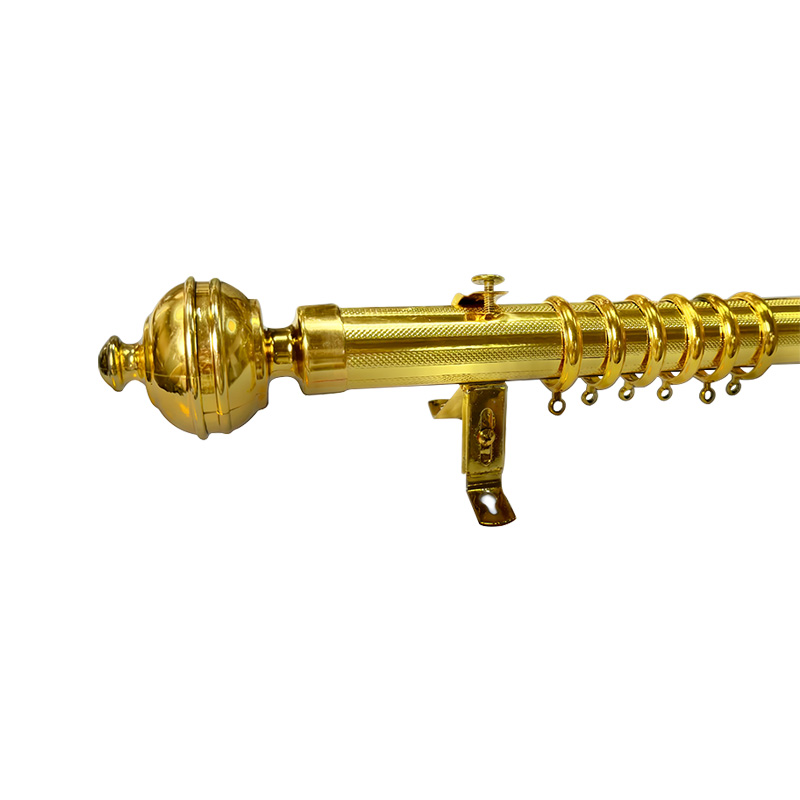
The Aluminum Curtain Rod is the most widely used curtain rod material for general residential and commercial applications worldwide. It balances low weight, complete corrosion resistance, broad finish availability, competitive cost, and adequate load capacity in a single material that works acceptably for almost every room type and curtain weight class.
Why Aluminum Is the Default Curtain Rod Material
- Corrosion resistance without maintenance: Aluminum forms a natural oxide layer on its surface that protects it from further corrosion even in humid environments. Unlike iron or steel rods, aluminum rods in kitchens and bathrooms do not require waxing, lacquering, or regular surface inspection to maintain their protective properties.
- Weight: A 28 mm aluminum rod at 180 cm weighs approximately 400 to 600 g, compared to 1.2 to 1.8 kg for a steel rod and 2.5 to 4 kg for a wrought iron rod of the same dimensions. The lighter weight makes aluminum rods easier to handle during installation and reduces the structural demand on the wall fixings.
- Load capacity: A 28 mm aluminum rod with brackets at 90 cm spacing carries 12 to 20 kg before visible deflection. A 35 mm aluminum rod at the same bracket spacing carries 25 to 35 kg. These figures cover the vast majority of residential curtain weight requirements.
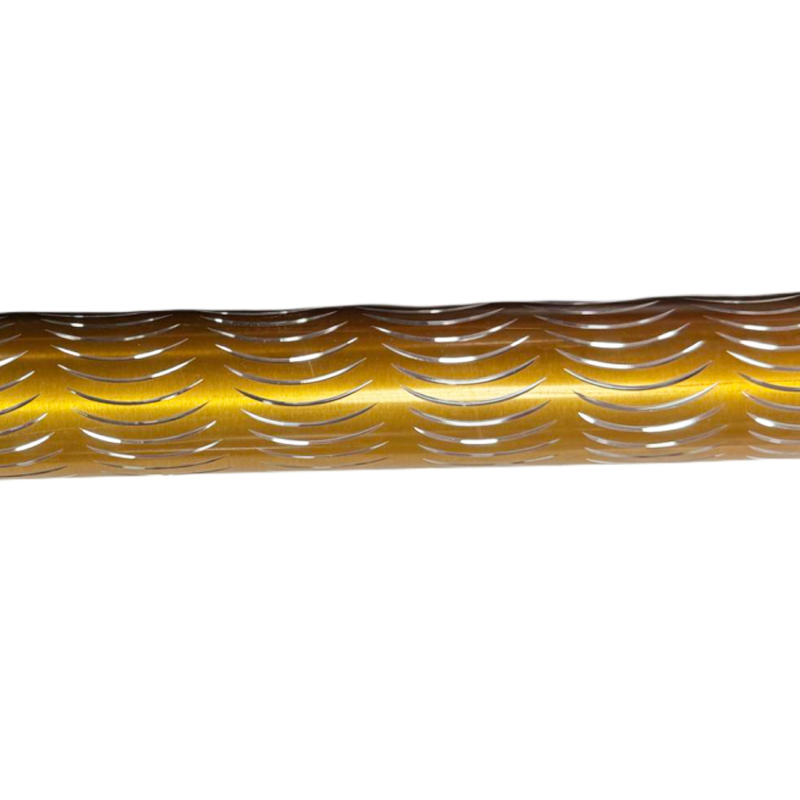
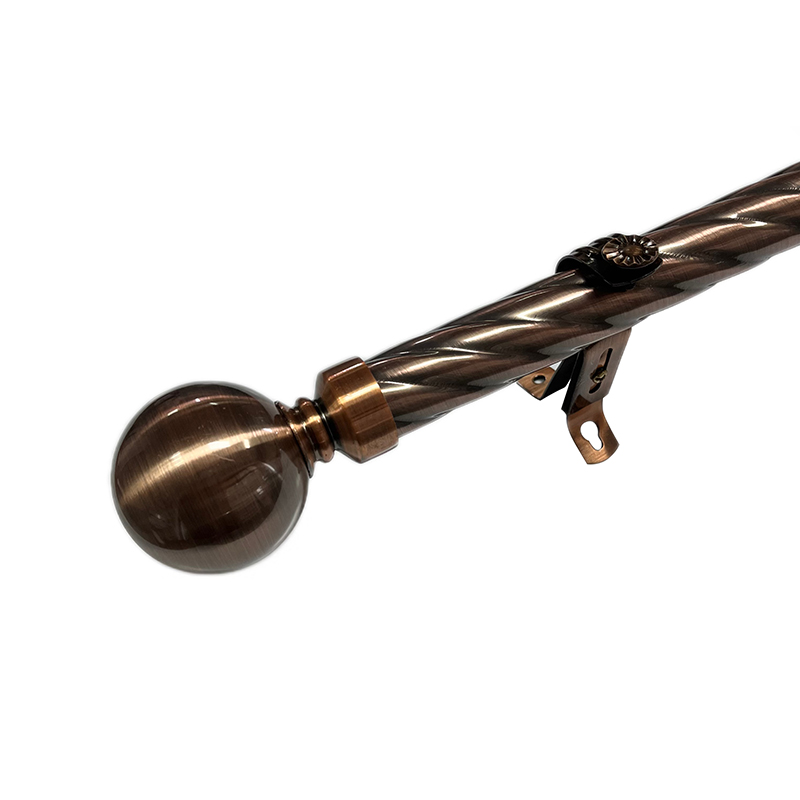
- Finish range: Aluminum rods are available in anodized and powder-coated finishes across the full spectrum of interior design requirements: silver, chrome, brushed nickel, bronze, gold, white, and matte black. This finish breadth means aluminum can serve both contemporary and traditional interior schemes.
- Cost: A 28 mm aluminum rod at 180 cm costs approximately $12 to $35 in standard retail, significantly less than an equivalent iron rod at $35 to $90 and dramatically less than premium wrought iron at $60 to $150.
When Aluminum Is Not the Right Choice
- Very heavy curtain loads above 35 kg: For extremely heavy fully interlined velvet or wool curtains in large-scale rooms, even a 35 mm aluminum rod may deflect visibly over spans above 200 cm. A wrought iron or steel rod of the same diameter is approximately three times stiffer for the same wall thickness.
- Period property aesthetic requirements: In a Victorian, Georgian, or Arts and Crafts interior where the curtain hardware is part of the architectural statement, a wrought iron or cast iron rod provides a visual mass and authenticity that anodized aluminum cannot replicate regardless of finish.
- Direct coastal marine exposure: Very close to the sea (within approximately 500 m of salt water), aluminum in contact with incompatible metals (brass or steel screws in aluminum brackets, or vice versa) can experience galvanic corrosion at the contact points. Specify all-aluminum hardware or use nylon isolating washers where aluminum contacts other metals in marine environments.
Iron Curtain Rod: Maximum Weight Capacity and Architectural Impact
An Iron Curtain Rod is the heaviest and most structurally capable curtain rod material option. "Iron curtain rod" as a product category covers several distinct products that share the iron base metal but differ significantly in manufacturing method, appearance, and performance. The two main types are wrought iron and cast iron, and understanding the difference is practical knowledge for anyone specifying curtain hardware for a period property, large-scale space, or design-led contemporary interior.
Wrought Iron Curtain Rods: Hand-Crafted Character
Wrought iron is produced by heating iron to a workable temperature and forming it by hand hammering or mechanical pressing. The working process gives wrought iron a characteristic fibrous grain structure visible on cut sections and a slightly irregular, organic surface that distinguishes it clearly from machine-produced steel. Wrought iron rods are specified in traditional, farmhouse, rustic, Arts and Crafts, and Mediterranean interior schemes where the material's visible character contributes to the room's atmosphere.
- Weight: A 25 mm wrought iron rod at 200 cm weighs approximately 2.5 to 4 kg. Always use masonry anchors into solid brick or concrete for wrought iron installations, as the combined weight of rod plus heavy curtains easily exceeds the capacity of standard plasterboard fixings.
- Stiffness: Iron is approximately 3 times stiffer than aluminum at the same diameter and wall thickness, allowing longer unsupported spans without deflection. A 25 mm wrought iron rod can typically span 200 to 250 cm without a center bracket under residential curtain loads.
- Finish and corrosion: Quality wrought iron rods are sealed with beeswax, lacquer, or powder coat at manufacture. The seal must be maintained: any chip or scratch in the coating in a humid environment will rust within weeks. Annual waxing with a clear protective wax maintains both appearance and rust prevention on unwaxed or lightly waxed finishes.
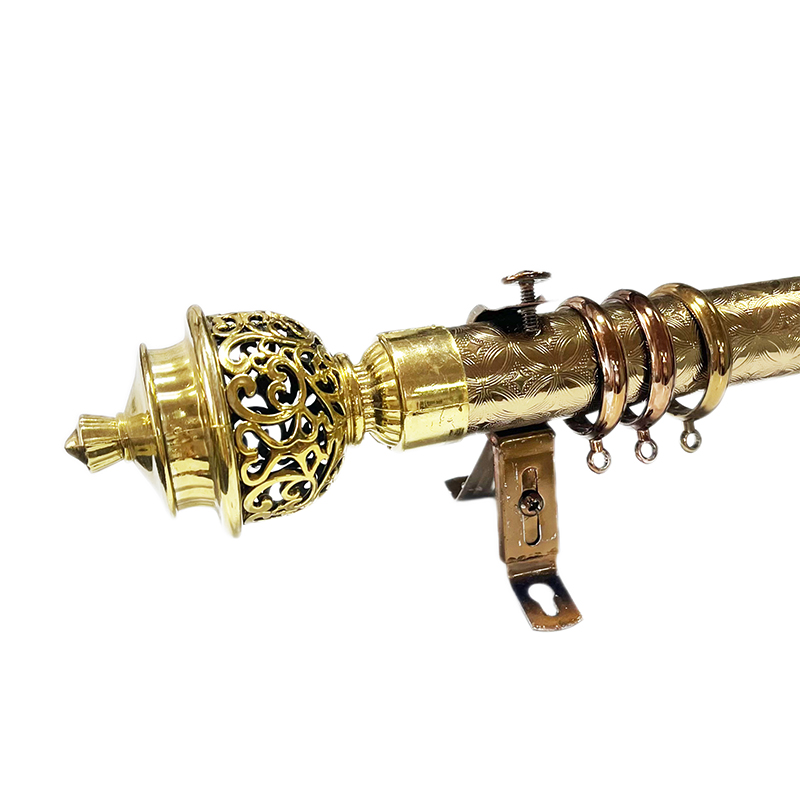
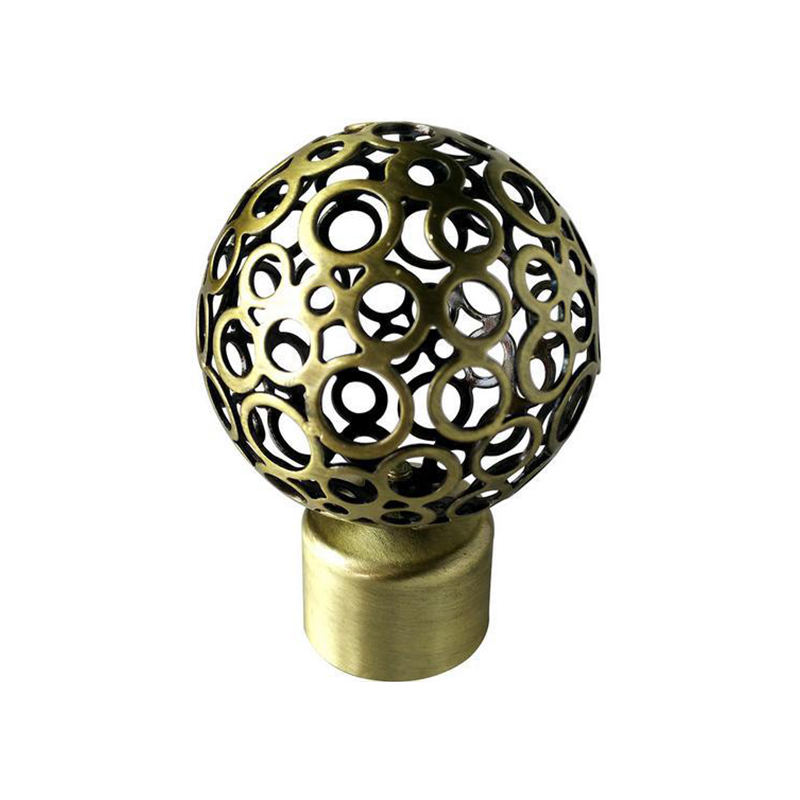
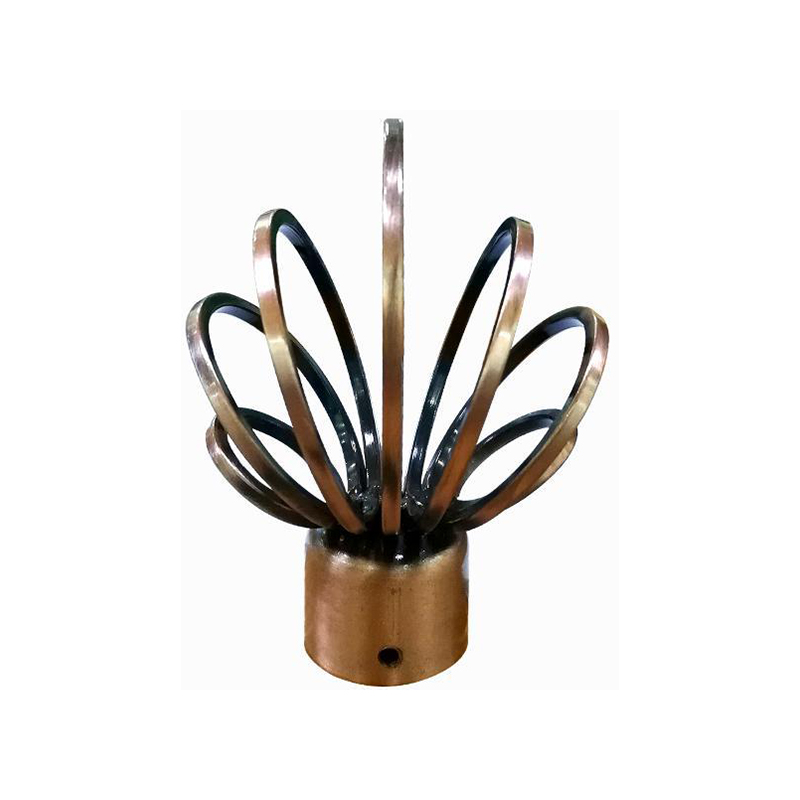
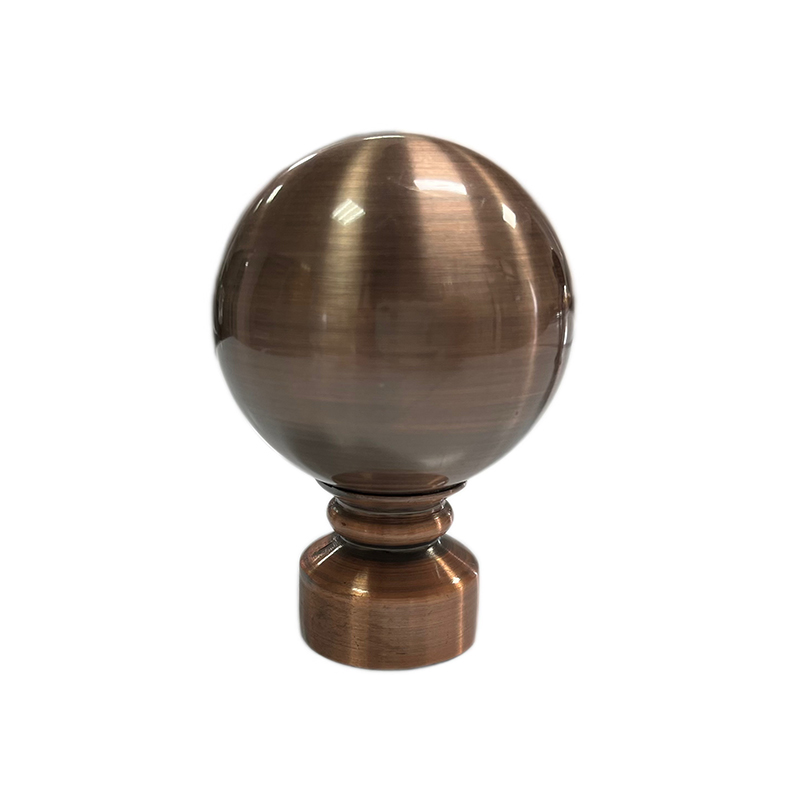
- Decorative details: Wrought iron rods are often finished with hand-forged finials in traditional motifs: spear points, scrolls, fleur-de-lis, acorns, and hammered ball ends. These decorative elements are one of the primary reasons for specifying wrought iron over aluminum or steel in design-led interiors.
Cast Iron Curtain Rails: Heritage Architecture and Bay Windows
Cast iron curtain rails differ from wrought iron rods in that they are track or channel profiles cast from molten iron poured into molds, rather than solid rods. They function as gliding tracks rather than decorative poles. Cast iron curtain rails were the standard in high-quality Victorian and Edwardian residential construction and are still produced by specialist heritage suppliers for period property restoration. They are also appropriate for very large contemporary rooms where their substantial visual presence suits the architectural scale.
- Bay window compatibility: Cast iron curtain rails are manufactured with precision corner sections in standard bay angles (90, 120, and 135 degrees) that match common Victorian bay window geometries, allowing the track to follow the exact bay profile. This precision fit is not achievable with flexible plastic tracks without visible kinks at the corners.
- Load rating: Cast iron curtain rails are rated for very high loads, typically 30 to 60 kg per linear meter, making them the appropriate choice for grand-scale rooms with very heavy curtains or multiple overlapping curtain panels.
- Professional installation: The weight of cast iron (a 1.5 m section can weigh 3 to 8 kg before hardware) and the precision required for bay window geometry make cast iron curtain rail installation a professional task. These are not DIY products in the conventional sense.
| Material | Weight (180 cm rod) | Max Load (28 mm, brackets at 90 cm) | Rust Risk | Best Room | Approximate Cost (180 cm) |
|---|---|---|---|---|---|
| PVC Curtain Rod | Under 300 g | Up to 7 kg | None | Bathroom, wet room | $5 to $18 |
| Aluminum Curtain Rod | 400 to 600 g | 12 to 20 kg | None | All rooms, general use | $12 to $35 |
| Iron Curtain Rod (wrought) | 2.5 to 4 kg | 30 to 45 kg | Moderate (if finish chips) | Living room, bedroom (traditional) | $35 to $120 |
Frequently Asked Questions About Curtain Rods
1. How do I install a curtain rod on a plasterboard wall without studs?
Use heavy-duty hollow wall anchors (toggle anchors or Fischer DuoPower anchors rated for plasterboard) for each bracket screw position. Standard plastic rawlplugs grip only the plasterboard surface and will pull out under sustained curtain load. A good hollow wall anchor in 12.5 mm plasterboard holds 15 to 25 kg per anchor, which is sufficient for most residential curtain rod brackets when two or three anchors are used per bracket. Never use sticky or self-adhesive strips as the primary fixing for a curtain rod bracket: they are not rated for sustained downward and outward loading.
2. Where should curtain rods be placed for the best visual effect?
Place the rod 15 to 20 cm above the window frame and extend it 20 to 25 cm beyond each side of the window for the best visual result in rooms with standard 2.4 to 2.7 m ceilings. For higher ceilings, mount the rod 15 cm below the ceiling line to maximize the perception of height. The wider the rod extends beyond the window frame, the wider the window appears and the more light enters when curtains are open. These two adjustments (high mounting plus wide extension) make the single biggest visual difference to how windows curtain rods look in a finished room.
3. What is a double curtain rod bracket and how is it different from a standard bracket?
A double curtain rod bracket has two arm projections from the same wall mount plate, one shorter (projecting approximately 5 to 7 cm from the wall) and one longer (projecting approximately 10 to 14 cm), so that two parallel rods can be held from the same bracket. A standard bracket has only one projection and holds one rod. The double bracket is used to install a double rod system (typically a sheer or voile inner rod and a heavier drape outer rod) from a single set of wall fixings rather than having to install two separate sets of brackets for the two layers.
4. What rod diameter should I use for heavy lined curtains?
For heavy fully lined or interlined curtains with a total weight of 15 to 30 kg, use a minimum 35 mm diameter aluminum or iron curtain rod with brackets no more than 90 cm apart. For curtain weights above 30 kg (which occurs in very wide windows with heavy fabrics such as velvet or wool), use a wrought iron rod of 35 to 50 mm diameter with brackets at 60 to 80 cm spacing and ensure all fixings go into solid masonry or structural timber.
5. Is a PVC curtain rod suitable for a bathroom?
Yes. A PVC Curtain Rod is the most appropriate choice for a bathroom or wet room because it does not rust or corrode from water, steam, soap, or standard bathroom cleaning products. PVC rods are suitable for shower curtains and lightweight window curtains in wet rooms. The limitation is load capacity: keep total curtain weight below 5 to 7 kg per rod and avoid spans above 120 cm without a center support. For heavier lined window curtains in a bathroom (where moisture is present but the curtain is not directly in the shower), a matte black anodized aluminum rod is a better choice as it handles greater weight while still being completely corrosion-resistant.
6. How do I stop a curtain rod from bowing in the middle?
To stop a curtain rod from bowing: add a center support bracket at the midpoint of the rod span. This is the most effective solution and is necessary for all rods spanning more than 180 cm under medium to heavy curtain loads. Alternatively, switch to a larger diameter rod (a 35 mm rod instead of 28 mm) which has significantly greater bending stiffness. As a last resort, switch from a lighter material (PVC or thin aluminum) to a heavier and stiffer material (thicker aluminum or iron rod) of the same diameter. The center bracket solution is always the most cost-effective approach.
7. What is the difference between an aluminum curtain rod and an iron curtain rod?
An Aluminum Curtain Rod is lightweight (400 to 600 g at 180 cm), completely corrosion-resistant without any maintenance, lower in cost, and available in a wider range of finishes. An Iron Curtain Rod is approximately 5 to 8 times heavier at the same size, requires protective coating maintenance to prevent rust, costs significantly more, but provides approximately 3 times greater stiffness for the same diameter and has a stronger architectural presence appropriate for period and large-scale interiors. Choose aluminum as the default; choose iron when the curtain weight or room aesthetic demands it.
8. How many brackets do I need for a curtain rod?
Use two end brackets for rods up to 180 cm long. Add one center bracket for rods between 180 cm and 270 cm. For rods above 270 cm, space brackets at a maximum of 90 cm intervals and add as many intermediate brackets as needed to achieve this spacing. For double curtain rod brackets, the same spacing rules apply but the bracket must carry the combined weight of both rods and both curtain layers, so verify the double bracket's total load rating before finalizing bracket spacing.
9. Can curtain rods be installed without drilling?
Yes, with limitations. Tension rods (spring-loaded or twist-to-extend PVC or aluminum rods) brace between two opposing surfaces without any wall fixings and are ideal for shower curtains and lightweight café curtains in window alcoves. The load capacity is limited to approximately 3 to 5 kg, making them unsuitable for lined or heavy curtains. For heavier curtains without drilling, no-drill bracket adhesive systems exist but are only rated for light loads and are not recommended as a permanent primary fixing for window curtain rods in regularly used rooms.
10. What curtain rod fitting is best for very heavy velvet curtains?
For very heavy velvet curtains (which can weigh 1 to 2 kg per square meter), use an enclosed ring bracket rather than an open cup bracket, because the enclosed ring prevents the rod from lifting out of the bracket under uneven loading when curtains are drawn. Pair the enclosed ring bracket with a minimum 35 mm diameter wrought iron or heavy aluminum rod, space brackets no more than 80 to 90 cm apart, and fix all brackets into solid masonry with 8 mm rawlplugs or directly into structural timber studs. Verify bracket load rating exceeds the total curtain weight by a factor of at least 1.5 to allow for dynamic loading from opening and closing the curtains.